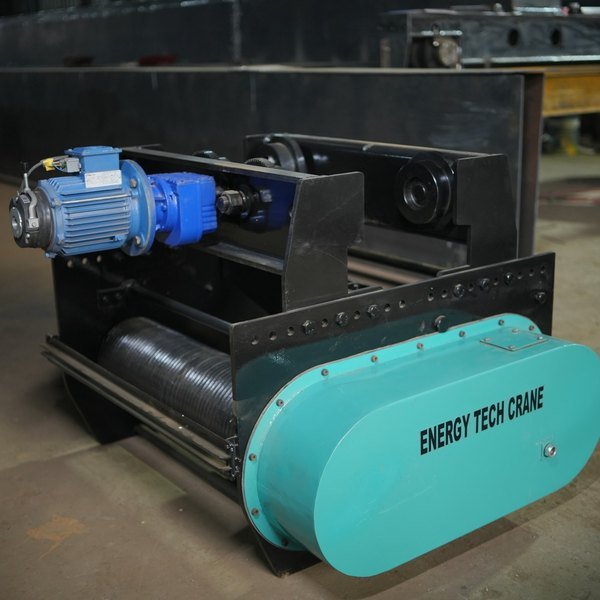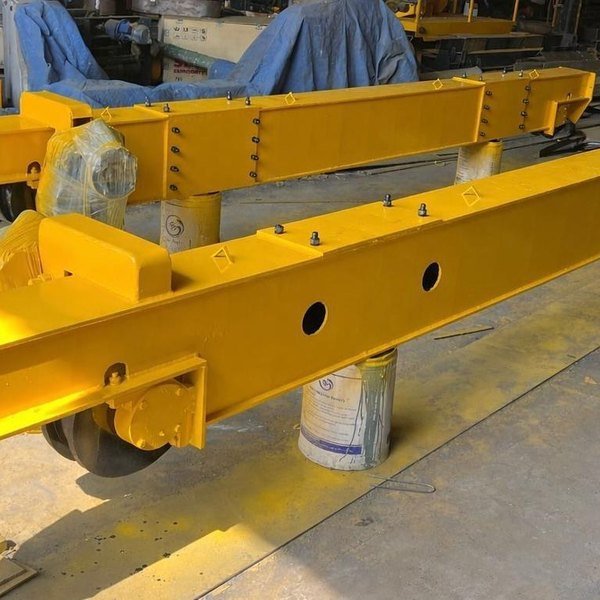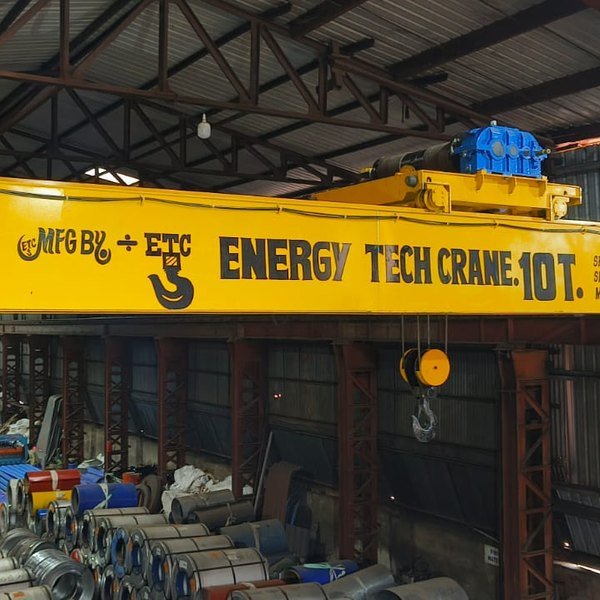
Double Girder EOT Cranes with two parallel bridge girders supporting a top-running trolley and hoisting mechanism. The robust twin-girder design enables higher capacities, longer spans and greater hook approaches — engineered to IS 3177, IS 807 and FEM 1.001.
| Capacity | 1 – 200 Ton |
| Span | Up to 50 m |
| Lift Height | Up to 50 m |
| Speed | Selected according to client application |
| Duty Class | M3, M5, M7, M8 (IS / BS / DIN) |
| Motors | Squirrel Cage / Slip Ring |
| Girder | Torsion-free fabricated box section |
| Wheels | Double-flanged forged, machined tread |
| Control | Pendant / Radio Remote / Cabin |
| Power Feed | DSL Busbar / Festoon Cable |
| Paint | Epoxy Primer + Epoxy Finish / PU Topcoat |
| Standards | IS 3177 · IS 807 · FEM 1.001 |
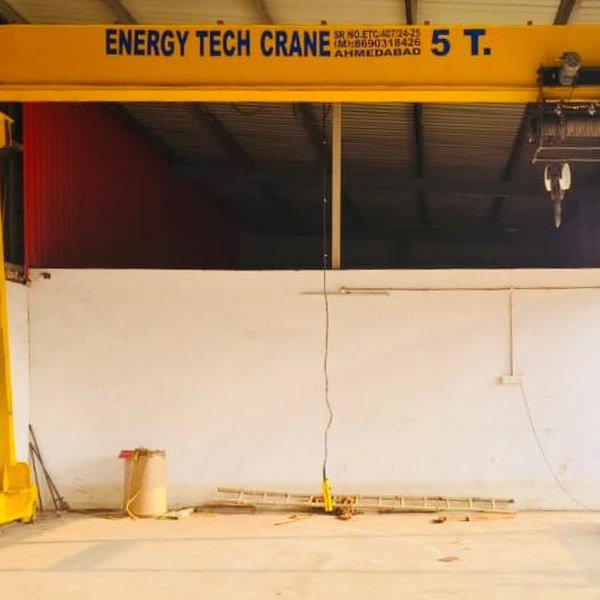
Double Girder EOT Cranes carry the crab trolley on rails atop two parallel torsion-free box girders, giving higher hook lift, better hook approaches at both ends, faster speeds and the structural rigidity heavy duty demands — with deflection held to a minimum even at full load. A maintenance walkway with hand railing runs along the bridge for safe access to the crab, panels and long-travel machinery. This is the machine for steel plants, fabrication industries, warehouses, power plants, foundries and engineering facilities where loads are serious and downtime is expensive.
Each bridge is engineered to IS 3177, IS 807 and IS 800 with FEM 1.001 mechanism classification: girder geometry, camber and diaphragm spacing are verified before welding by qualified welders, critical joints are NDT-checked, hook forgings carry magnetic-particle test certificates, and the completed crane is proof-tested at 125% SWL. Long-travel end carriages run double-flanged forged wheels on sealed bearings, multiple hoisting trolleys can share one bridge, and cabin, radio remote and creep-speed VFD options position the heaviest loads with millimetre precision.
Share your building drawing — our design team returns wheel loads, clearance diagram and GA drawing with the quotation.
Electronic load cell cuts hoisting the moment load exceeds rated SWL.
Rotary geared and counterweight limits stop hook over-travel in both directions.
Audible alarm and flasher warn floor staff during LT/CT travel.
Electromagnetic brakes engage automatically on power failure — load holds instantly.
IP-65 push-button pendant with optional wireless remote and emergency stop.
SPP, overload relays and single-phase preventers protect motors and VFDs.
We engineer double girder EOT cranes from 1 to 200 Ton with spans up to 50 metres — including multiple hoisting trolleys on one bridge where your process needs tandem lifts. Above-standard capacities and special duty classifications are designed on request against your load spectrum.
Continuous production duty typically requires Class III/IV (M7–M8) mechanisms per IS 3177 / FEM 1.001 — heavier gear modules, bigger brakes and higher motor CDF ratings. We classify formally from your lifts-per-hour data.
Squirrel cage motors with VFDs are today's standard for smooth control and low maintenance. Slip ring motors remain available where site preference or very high starting torque under load demands them — both in genuine crane-duty ratings.
Structures follow IS 807 and IS 3177 with FEM 1.001 mechanism groups; plates are mill-certified IS 2062; and every crane is load-tested at 125% SWL at our works — witnessed, documented and stamped.
If your building columns can carry a runway, an EOT crane uses your existing structure economically. Where no building exists — open yards, stockyards — a gantry or goliath running on floor rails is the answer. Send site photos and we'll advise.
Yes. We regularly design cranes onto existing rails — wheel gauge, rail size, DSL or festoon systems are measured and matched, and end carriages are machined to suit your runway alignment.
12-month standard warranty, AMC programs with scheduled preventive visits, statutory load-test recertification, lifetime spares support and 24×7 breakdown response with engineers across India.
Double girder cranes typically ship in 6–10 weeks depending on capacity, with erection, alignment and commissioning by ETC rigging teams — most installations are handed over running within a week on site.
Answer a few quick questions and our team will prepare a detailed techno-commercial quotation within 24 hours.
Send your capacity, span and lift height — a detailed techno-commercial quotation reaches you within 24 hours.